

For the 3 rd time Anna of Anna’s Cool Finds asked for A taste of terroir.
I already mentioned that I live in the northernmost Bundesland of Germany, Schleswig-Holstein: The land between two seas, between the Baltic Sea and the North Sea. Until 1864 the northern part Schleswig belonged to Denmark, where the writer and lyricist Theodor Storm was born. One of his favourite dishes were Förtchen, in Danish Æbleskiver. He liked the German version so much, that he wrote a nursery rhyme about Futtjes, low German for Förtchen.
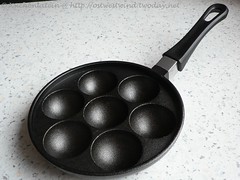
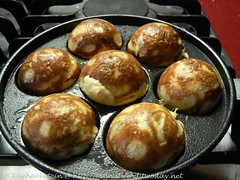
You need a special pan to bake Fö;rtchen. My grandmother had a pan with 7 indentations for a gas stove, my mother in law has a large pan for a coal-fired stove like this. Meanwhile you can buy pans with plain bottoms for electrical stoves. I borrowed this pan for baking Förtchen
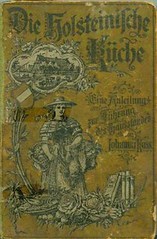
There are different batters for Förtchen in all regions of Schleswig-Holstein. This cookbook from 1920 has 5 different recipes for Förtchen. The book recommends a mixture of lard and butter. My grandmother always baked them with yeast and raisins, so did I.
 |
 |
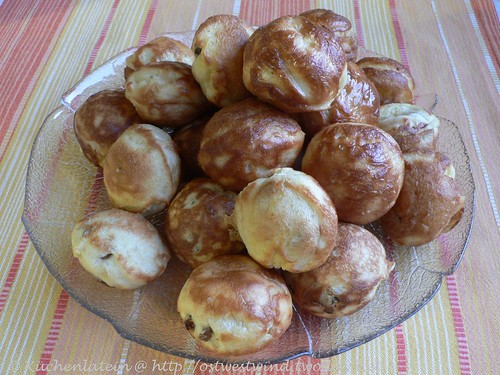
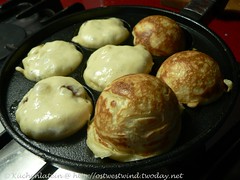
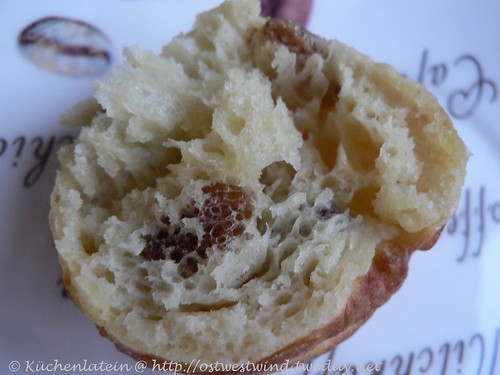
The Förtchen are done if they look inside like this.
Link to the Æbleskiver recipe in German language
I’ve been wanting to buy one of those pans. They look great!
Does anyone see this page anymore? The old book you showed looks fascinating! My family came from Schleswig-Holstein, several generations back, and my maiden name is Holst. The family has a recipe similar to this one, that they call “fürden”… I assume that their name is a corruption of the original word. They also make a pfeffernüsse recipe that contains black coffee and molasses, as well as various spices… It’s not like any other pfeffernüsse recipe I’ve seen, and I have long wondered where it came from. I’m also curious about cookie and bread history, and what my ancestors might have made before white sugar and baking powder and white flour became common.
Hello Holly,
I make Holsteiner Pfeffernüsse without coffee but with molasses and lots of spices. They are made with potash (potassium carbonate) and „deer horn salt“, that is ammonium bicarbonate. Comes this recipe close to yours?
I just saw this after five years!😆 Sorry about that!
I’m not sure how close my recipe is to this one, as unfortunately I can’t read German. the original recipe I have has:
-1 quart milk
-3/4 cup lard & butter (hslf & half)
-2 tsp. salt
-1/2 tsp. cinnamon
-12 cardamom seeds (remove shells & crush seeds)
-1/2 cup sugar
-5 eggs
-1 cake yeast
-5 1/2 cups flour
-1 grated lemon rind
-soaked raisins
-Extra sugar, for rolling in afterwards
(When I make this recipe nowadays, I use half those amounts and I also make various modifications for health reasons… for instance, I use whole wheat flour, and sourdough starter instead of yeast, as I suspect both of those might have been used at some point. (And anyway, I prefer them). 😉
That’s certainly a delicious recipe too. But the proportions of milk, sugar, and flour are different. My „förtchen“ are much less sweet and are never baked with sourdough in my family. Your measurements come first and I weigh everything!
946/250 ml milk
135-170/65 grams fat
100/15 grams sugar
5/3 eggs
40/25 grams yeast
680/200 grams flour
Based on the eggs, your recipe is 1.6 times the amount, but you use 4 times the amount of flour and 6 times the amount of sugar.
YUM! Interesting that this uses yeast!